
By Melissa Bateson. An introduction to Egyptian Mau colour genetics for breeders.
When I first started breeding Maus in 1996 cat colour genetics were a complete mystery to me. I asked some other breeders for explanations and was told rules of the type ‘smoke x smoke = smoke and black’, ‘bronze x bronze = bronze and black’ and ‘silver x silver = anything’. Although these rules are correct, it turns out that they are too general to be very useful. I wanted to breed silvers, but although my first two litters were from silver to silver breedings I got a complete rainbow of kittens: a total of four silvers, two bronzes, a smoke and two blacks… Why was I being so unlucky when I saw other breeders having litter after litter of silvers? Finally I began to understand when my breeder friend Melanie Morgan sent me an article on Mau colour genetics written by Kerry Conway of Kaakhamit cattery. I realized that with a little detective work I could have much greater control of the colours of my future kittens. I think Melanie and I spent about two hours on the phone excitedly trying to work out the genetics of all of our cats. It has been well worth the effort. In 2001 I had three litters of kittens — one of two, one of six and one of eight — ALL silvers! My intention in this article is to introduce breeders to the genetics of the four basic Mau colours, and provide some simple rules for predicting the outcomes of different matings. I have not included the blues or classic tabbies here because they are very rare and hugely increase the number of possibilities that need to be considered.
Egyptian Mau Genetic Colour Chart. The colour table referred to throughout this article — showing the average proportions of each colour from every possible pairing of genotypes — is available as a downloadable PDF. Download the Egyptian Mau Genetic Colour Chart (PDF)
The silver Mau is genetically a black silver spotted tabby
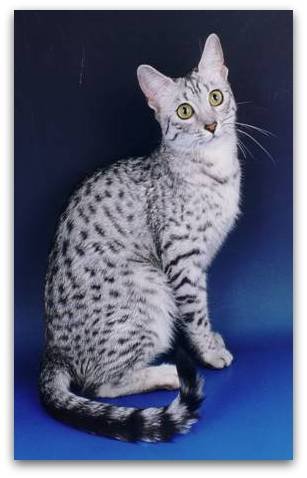
The equivalent colour is also found in breeds such as the British Shorthair, the Oriental and the Ocicat, but note that the silver Mau is genetically completely different from the snow Bengal, whose pale colour is produced by the Siamese or Burmese colour restriction gene, not the silver gene. The colour and pattern of the silver Mau are produced by the addition of just two dominant alleles (variants of a gene) to the solid black Mau: the inhibitor allele, I, and the agouti allele, A. The dominant inhibitor allele, as its name suggests, inhibits the deposition of brown colour in the hairs and is thus responsible for the silver colour. The dominant agouti allele causes pigment in the hairs to be deposited in bands along the hair producing the effect known as ticking. The presence of the agouti allele, A, is necessary for the tabby pattern to be clearly seen. A Mau with AT LEAST ONE I allele AND AT LEAST ONE A allele will be a silver. Therefore, since each cat has two copies of each gene, one inherited from the dam and one from the sire, there are four different types of silver Mau (known as genotypes). A cat is referred to as homozygous for a particular gene if both alleles are the same, and heterozygous if they are different. Hence the four genotypes of silver Mau can be described as follows:
- AAII = silver homozygous for the inhibitor and agouti alleles, i.e. pure silver
- AAIi = silver heterozygous for the inhibitor allele, i.e. carrying bronze
- AaII = silver heterozygous for the agouti allele, i.e. carrying smoke
- AaIi = silver heterozygous for both inhibitor and agouti alleles, i.e. carrying both smoke and bronze
There is some debate about whether or not these four different genotypes have different physical appearances (known as phenotypes) associated with them. There is some evidence from other breeds (e.g. Persians) that although the I allele is dominant, its effects are somewhat additive. Thus a cat with two copies of the I allele might show greater inhibition of colour than a cat with just one. We might therefore expect II silvers to be less tarnished (i.e. have less yellow or brown colouration) than their Ii littermates. This hypothesis remains to be tested; however, based on my own limited observations it does seem to be the case that silvers with tarnish are more likely to carry bronze (i.e. have the Ii genotype) than their cleaner-coloured litter mates.
Aside from the possibility of phenotypic differences between the four types of silvers, the genotype of a cat has important implications for breeding. By the judicious pairing of cats of known genotype it is possible to control the number of colours that can occur in the offspring. The colour table I have created shows the proportions of different colours that will arise on average from all the possible pairings of Mau genotypes. To use the table all you need to do is (1) determine the genotype of your cat, (2) determine the genotype of the cat it will be mated to, and (3) read off the average percentages of different colours from the appropriate cell of the table. Neither the agouti nor the inhibitor genes are sex-linked, thus it is not relevant which cat is the dam and which the sire. Bear in mind that unless the percentage given is 100%, in which case you can predict exactly what you will get, these percentages represent the AVERAGES ONLY, and you are unlikely to get exactly the given percentage in any single litter. Although, if the mating is repeated many times, the proportions of kittens of different colours produced should approach the percentages in the table.
Determining the genotype of a silver. First look at the kittens your cat has produced. This is the most reliable method of determining a cat’s genotype.
- If your cat has produced a bronze kitten ever, then it is carrying bronze (Ii)
- If your cat has produced a smoke kitten, then it is carrying smoke (Aa)
- If your cat has produced both bronze and smoke offspring, then it is carrying both bronze and smoke (AaIi)
- If your cat has produced a black, then it is carrying both bronze and smoke (AaIi)
- If your cat has only had silver kittens, then you know nothing certain unless it has been bred multiple times to a cat known to be carrying smoke and bronze, in which case it is likely to be a pure silver (AAII)
Second, look at your cat’s pedigree. This is less reliable because it depends on the pedigree being correct.
- If your cat has a bronze parent, then it is carrying bronze (Ii)
- If your cat has a smoke parent, then it is carrying smoke (Aa)
- If your cat has one bronze and one smoke parent, then it is carrying both bronze and smoke (AaIi)
- If your cat has a black parent, then it is carrying both bronze and smoke (AaIi)
- If you know the genotypes of the cat’s parents and/or grandparents this can help you determine what colours your cat has a probability of carrying
Third, look at your cat. This method is not proven to be reliable at this stage. If your cat is tarnished relative to other silver litter mates, it may be carrying bronze (Ii).
Genetically the bronze Mau is a brown (i.e. black) spotted tabby
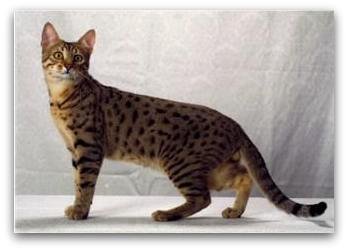
Brown tabbies are known in many breeds such as, for example, the British Shorthair, the Ocicat, and the Oriental; however, the warmer bronze colour of the Mau is only seen in the brown Bengals and the usual Abyssinians. The bronze colour is achieved by the addition of the dominant agouti allele, A, to the solid black Mau; thus a bronze is a Mau with AT LEAST ONE A allele. As in the silvers, the agouti gene causes ticking on the hairs revealing the spotted tabby pattern. Bronzes lack the dominant inhibitor allele found in the silvers and smokes. There are two distinct bronze genotypes determined by whether the cat has one or two copies of the dominant agouti allele:
- AAii = homozygous bronze, i.e. pure bronze
- Aaii = bronze heterozygous for the agouti allele, i.e. bronze carrying smoke
The warmness of the coat colour is determined by the presence of what are known as ‘rufous polygenes’. As their name suggests there are many of these genes, and the more a bronze Mau has, the warmer its colour will be. The usual Abyssinian is an example of another brown tabby (in this case of the ticked rather than the spotted pattern) that has been selected for a large number of rufous polygenes. The practice of breeding bronze to bronze generation after generation (known as ‘colour breeding’) paired with the selection of the warmest cats from each generation causes the accumulation of rufous polygenes within a line that is necessary to produce really warm bronzes. Breeding programs for warm bronzes and clean silvers probably cannot be successfully combined, since the rufous polygenes necessary for warm bronzes will result in tarnished silvers.
Determining the genotype of a bronze. First look at the kittens your cat has produced previously. If your cat has produced a smoke, then it is carrying smoke (Aaii). If your cat has produced a black, then it is carrying smoke (Aaii). If your cat has only had bronze and/or silver kittens, then you know nothing certain about its genotype unless it has been bred multiple times to a cat that is either smoke or known to be carrying smoke, in which case it is likely that it is a pure bronze (AAii). Second, look at your cat’s pedigree: if your cat has a smoke parent, or a black parent, then it is carrying smoke (Aaii).
Genetically the smoke Mau is a non-agouti black smoke cat
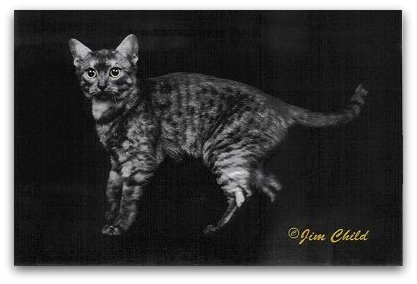
…that has been selected to have very prominent ghost markings. A smoke Mau has AT LEAST ONE inhibitor, I, allele, but lacks the agouti, A, allele. Thus despite its markings the smoke is not a tabby (i.e. agouti) cat. Egyptian Maus are unusual in having a patterned smoke. There is no equivalent of the smoke Mau in other breeds since, although black smoke exists as a colour in many breeds, these other smokes are preferred to show no tabby markings.
Smoke Maus are often used in silver breeding programs. Mixing smokes and silvers is not fraught with the same problems as mixing warm bronzes and silvers because with both the smokes and silvers it is desirable to select for as few of the tarnishing rufous polygenes as possible. Thus silvers and smokes can be interbred without detriment to either colour. On the contrary, some breeders maintain that smokes are actually useful for producing silvers with a high level of contrast between the spots and ground colour. It is certainly the case that some of the most black and white silvers I have seen have been produced from smoke to silver matings. My own preferred explanation is that smokes retained for breeding tend to have exceptional contrast relative to the pool of all smokes, and it is this selection that carries through to their silver offspring — implying you do not have to breed to smoke to get contrast; the same could be achieved by breeding from the highest-contrast silvers. As with the bronzes, there are two distinct smoke genotypes determined by whether the cat has one or two copies of the dominant inhibitor allele:
- aaII = homozygous smoke, i.e. pure smoke
- aaIi = smoke heterozygous for the inhibitor allele, i.e. smoke carrying bronze
Determining the genotype of a smoke. First look at the kittens your cat has produced previously. If your cat has produced a bronze, then it is carrying bronze (aaIi). If your cat has produced a black, then it is carrying bronze (aaIi). If your cat has only had smoke and/or silver kittens, then you know nothing certain about its genotype unless it has been bred multiple times to a cat that is either bronze or known to be carrying bronze, in which case it is likely that it is a pure smoke (aaII). Second, look at your cat’s pedigree: if your cat has a bronze parent, or a black parent, then it is carrying bronze (aaIi).
Genetically the black Mau is a plain non-agouti black cat
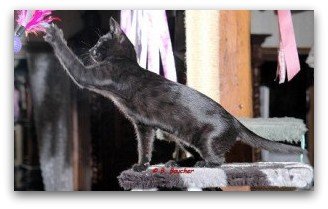
…with the black masking the spotted tabby pattern. There is only one type of black Mau, aaii, and it is the most recessive of the many Mau genotypes (excluding the blues). The fixed genotype of the black Mau, aaii, gives it specific uses in a breeding program. Blacks can be used to perform test crosses to reveal the genotypes of other cats. For example, if a silver is bred to a black and produces only silver kittens time after time, then the chances are very good that the genotype of this silver is AAII.
The downside of using a black in a breeding program is that it is equivalent to choosing a breeding cat with your eyes closed! Given the importance attributed to colour, pattern and contrast in the Mau standard, using a black Mau in a breeding program is not something to be undertaken without some thought. The black masks not only the pattern, making it hard to see whether the cat has any pattern faults and how good its contrast is, but also the rufous polygenes, making it impossible to tell how tarnished it is. It’s important to remember that just because you can’t see the pattern, contrast and tarnish, it does not mean that there are no genes for these traits present; they are there, you just can’t see their consequences. Of course the black Mau’s parents can be used to get some idea about the pattern and contrast genes it is carrying and the number of rufous polygenes it is likely to have. A second problem of breeding from blacks is that the probability of producing black kittens is greatly increased. In general it is not advisable to breed from a black Mau unless it comes from irreplaceable lines or it has absolutely outstanding health, temperament, type and eye colour.
New to breeding Egyptian Maus, or planning a litter? Join the Egyptian Mau Club to connect with experienced breeders and get friendly advice.
Related reading: Egyptian Mau breed facts and figures, the Egyptian Mau Standard of Points and the origins and history of the Egyptian Mau. Return to The Egyptian Mau breed guide.